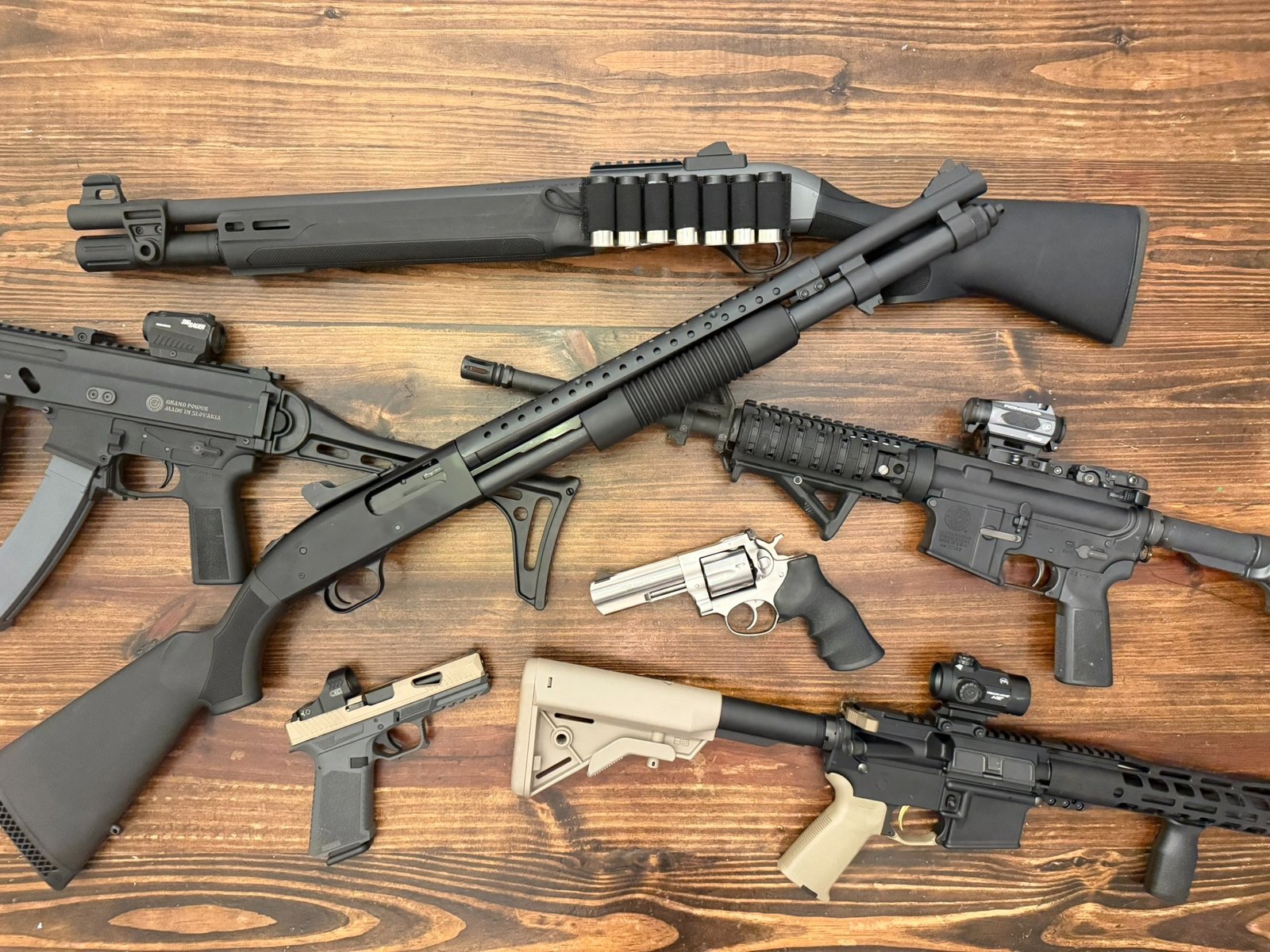
Home Defense Ammunition Explained
A practical guide to home defense ammunition: understand penetration, expansion, and overpenetration, plus how to choose handgun, rifle, and shotgun ammo for home defense that fits your setup.
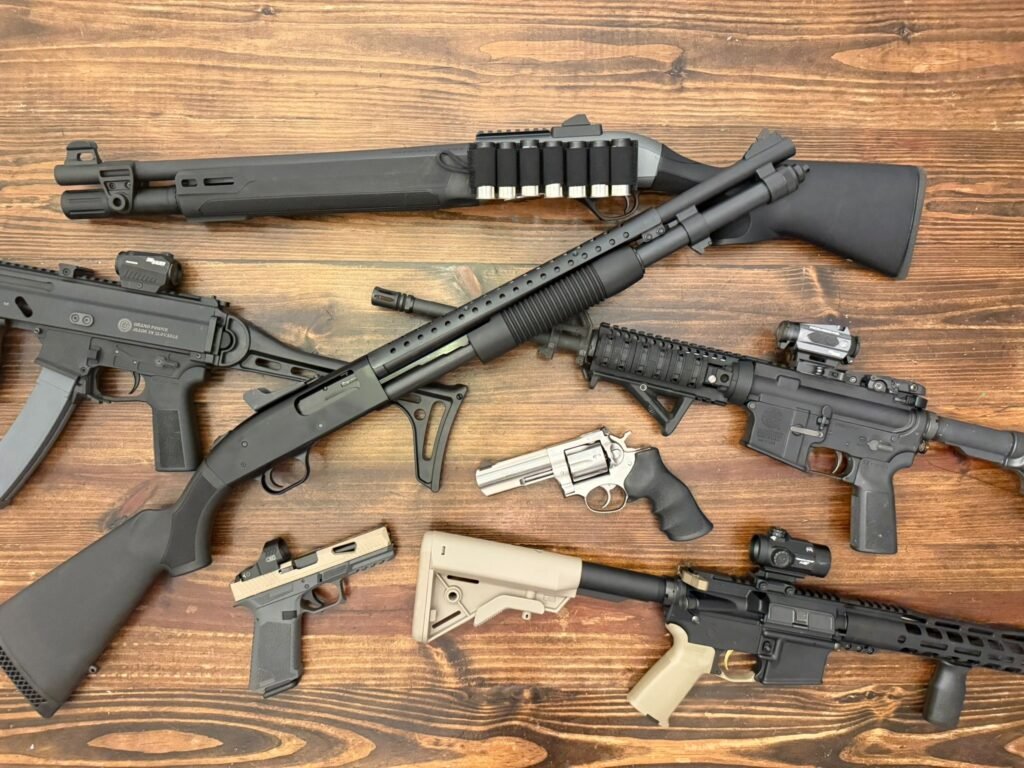
Introduction: Where Home Defense Ammunition Fits in a Home Defense System
Ammunition is often an overlooked aspect of your home defense setup. People spend time thinking about their firearms, optics, lights, and storage, but then grab whatever ammo is cheapest to actually feed their firearm.
That plan works fine until you stop and ask a simple question. What do you actually expect the ammunition to do?
In a home defense context, ammunition is not just an accessory. It is an integral part of the system. It influences how the firearm behaves, how predictable the outcome is, and how much responsibility the shooter carries. Remember, you are responsible for every round that is fired.
In this article, we are not picking out a specific load or professing loyalty to a brand. This article explores the roles and trade-offs of ammunition. Handgun, rifle, and shotgun ammo all solve the same problem but in different ways. Each introduces its own limitations along the way.
If you already have a broad home defense plan in place, this guide is designed to fit into it. If you do not, it is written to pair with our Home Defense Setup article and help you create a system that works for you.
What Home Defense Ammunition Must Do in a Home Defense Context
At a minimum, defensive ammunition has to work. Every time you pull the trigger, it has to go bang. You can’t have failure to feed (FTF) or failure to eject (FTE) issues, ever. Reliability is the floor. If your ammunition does not feed, fire, or cycle consistently in your firearm, nothing else matters. Past that point, things get more complicated.
Ammunition also has to behave in a way you can reasonably account for. Every projectile that leaves the muzzle belongs to you until it stops. That reality does not change based on caliber, platform, or intention.
This is where tradeoffs start to appear. Penetration is necessary, but too much of it creates problems. Expansion can help manage that, but it is not guaranteed. Misses are still misses. Walls are still walls.
Good ammunition does not eliminate risk. It helps you manage it.
Penetration, Expansion, and Overpenetration: The Shared Physics
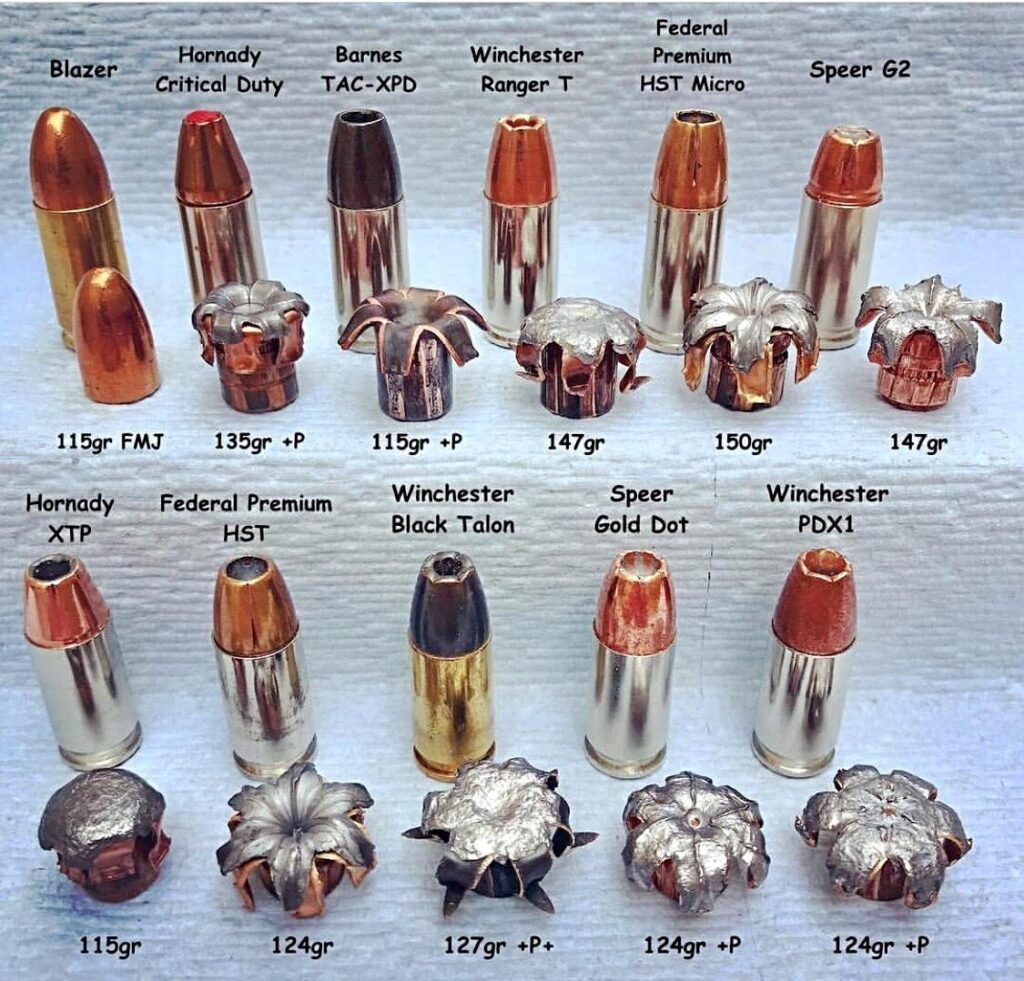
All defensive ammunition is governed by the same basic rules, regardless of platform. We need to look at penetration and expansion.
Penetration describes how far a projectile travels through a target. Without enough penetration, a projectile may fail to reach structures that actually stop a threat. The FBI documents classify that at least 12 inches of penetration is needed. Insufficient penetration isn’t hypothetical; it’s one of the main reasons rounds fail to stop a determined attacker. You have to cause enough damage to stop the threat.
Expansion exists to help control that penetration. By increasing resistance as the projectile travels, expansion can slow the projectile and reduce the chance that it exits the target with significant energy remaining.
Expansion is also crucial for increasing the amount of energy imparted to your target. Think of stopping power. If you shoot your target with a full metal jacket (FMJ), there is a very real possibility that it will poke a neat hole and do little actual damage to your target if you miss vitals and bones. A jacketed hollow point, conversely, should expand and dump its energy into your target. This both limits expansion and significantly increases the stopping power of your rounds.
Overpenetration occurs when a projectile continues to travel beyond the intended target. It is often treated as something that can be engineered away completely. It cannot. Walls, doors, and furniture are inconsistent barriers. Missed shots frequently pose a greater risk than pass-throughs.
Bullet types matter in these contexts. Full-metal-jacket ammo is the most common, but it may punch a neat hole in your target. Jacketed hollow points and soft points are designed to dump their energy into the target and therefore exhibit less penetration.
Frangible ammunition has gained popularity over the last decade as a means to mitigate the risk of overpenetration. It does this by being designed to break up on contact with somewhat hard surfaces like walls and furniture, while maintaining as much effectiveness as possible with your defensive loadings.
These principles apply to handguns, rifles, and shotguns alike. What changes is how each platform gets there, and what it asks of the person behind it.
Handgun Ammo for Home Defense: Role and Tradeoffs
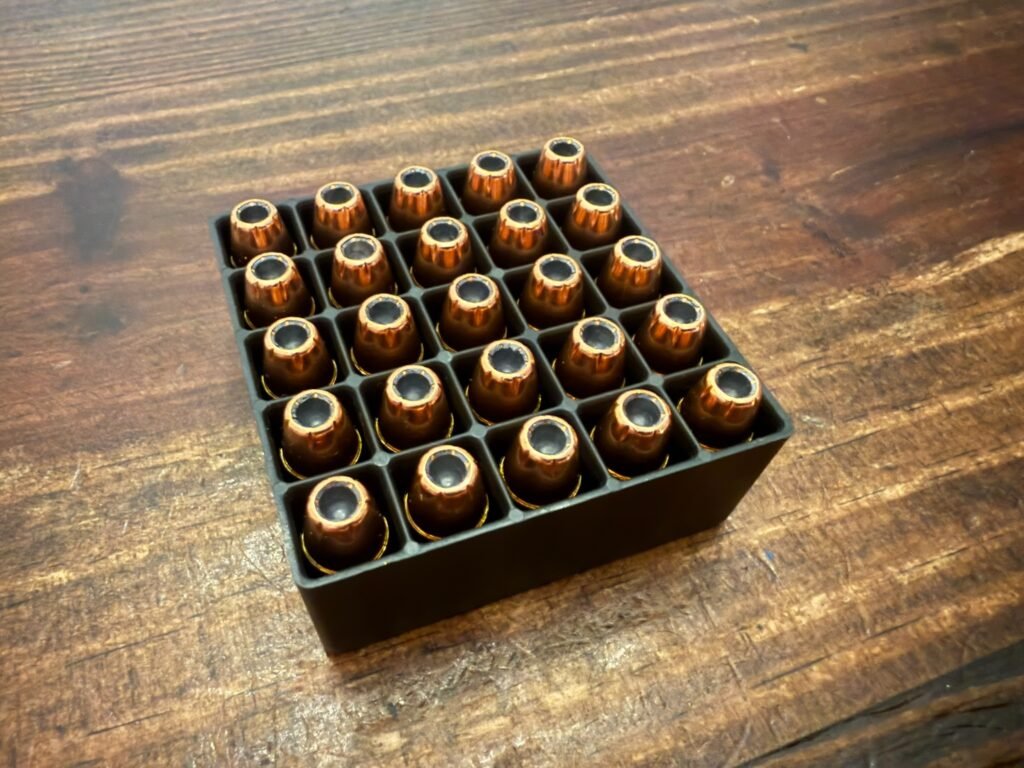
Handguns are popular for home defense because they are compact, accessible, and easier to store. 9mm is the most popular handgun ammo in 21st-century America, but plenty of others are in use as well. .380 ACP, .45 ACP, and 10MM to name a few.
Ammunition for those cartridges has to work at lower velocities and lower overall energy than long-gun ammunition. This makes ammo selection crucial to neutralizing the threat.
Handgun ammunition leans heavily on shot placement and bullet expansion, coupled with adequate penetration. There are countless videos of law enforcement officers shooting a suspect who shrugs off multiple bullets to keep attacking the officers. The terminal ballistics of handgun cartridges, while effective in most circumstances, do not approach those of rifles and shotguns. You need realistic expectations of what your handgun ammunition can do.
The trade is simple. Handguns offer flexibility and accessibility, but they demand more from the user. This means more is demanded of the ammo as well. It is not ineffective, but it is less forgiving.
Rifle Ammo for Home Defense: Role and Tradeoffs
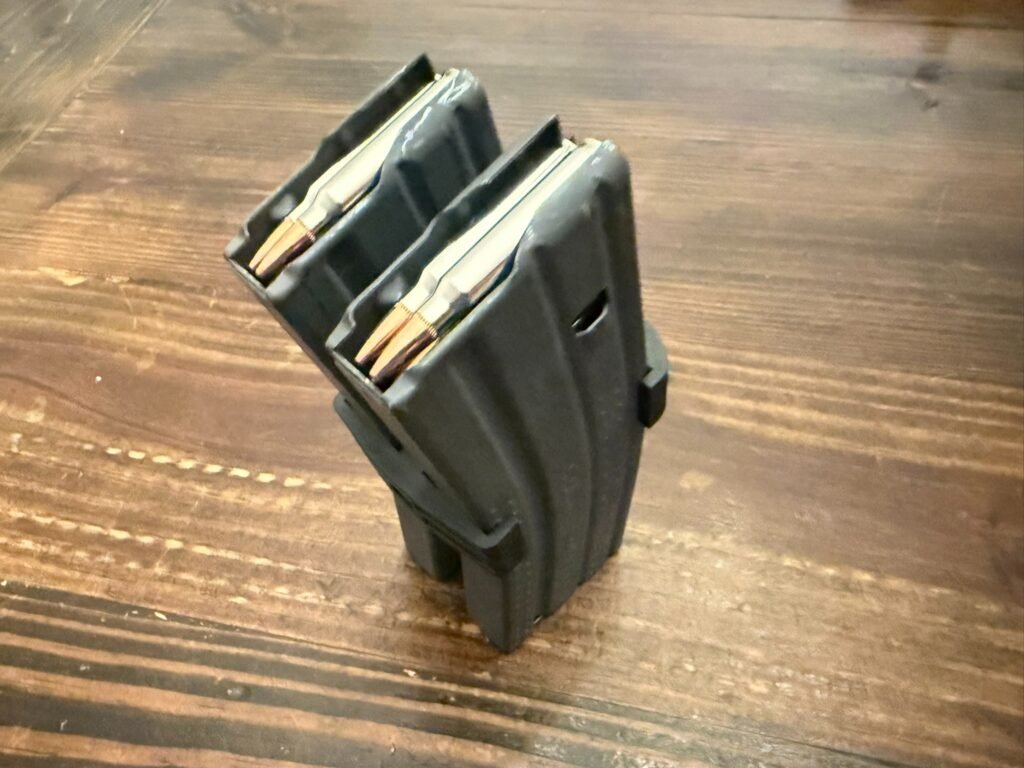
Rifle ammunition sets itself apart from pistol and shotgun ammunition through its increased velocity. Rifle ammunition, think .223/5.56 or .308, is usually moving significantly faster than shotgun and handgun ammo.
Higher velocity alters how projectiles behave when they strike a target, encounter barriers, or pass through intermediate materials. That can offer advantages in precision and effectiveness, especially for users who are comfortable with the platform.
Even FMJs can be very effective as rifle velocities. Higher velocity also raises the stakes. Mistakes can have catastrophic consequences.
Penetration is a significantly high risk factor with rifle ammunition. Accountability for shots fired extends further, literally. A bullet traveling 3,000 feet per second is going to get a lot further than one traveling 1,000 feet per second. This concern doesn’t make rifles unsuitable for home defense, but it does make ammunition selection and awareness more critical.
The tradeoff here is not power versus weakness. It is capability versus responsibility.
A platform comparison and deeper discussions about rifles and carbines will be handled in an upcoming article. For now, we are providing some context, not a verdict.
Shotgun Ammo for Home Defense, Role and Tradeoffs
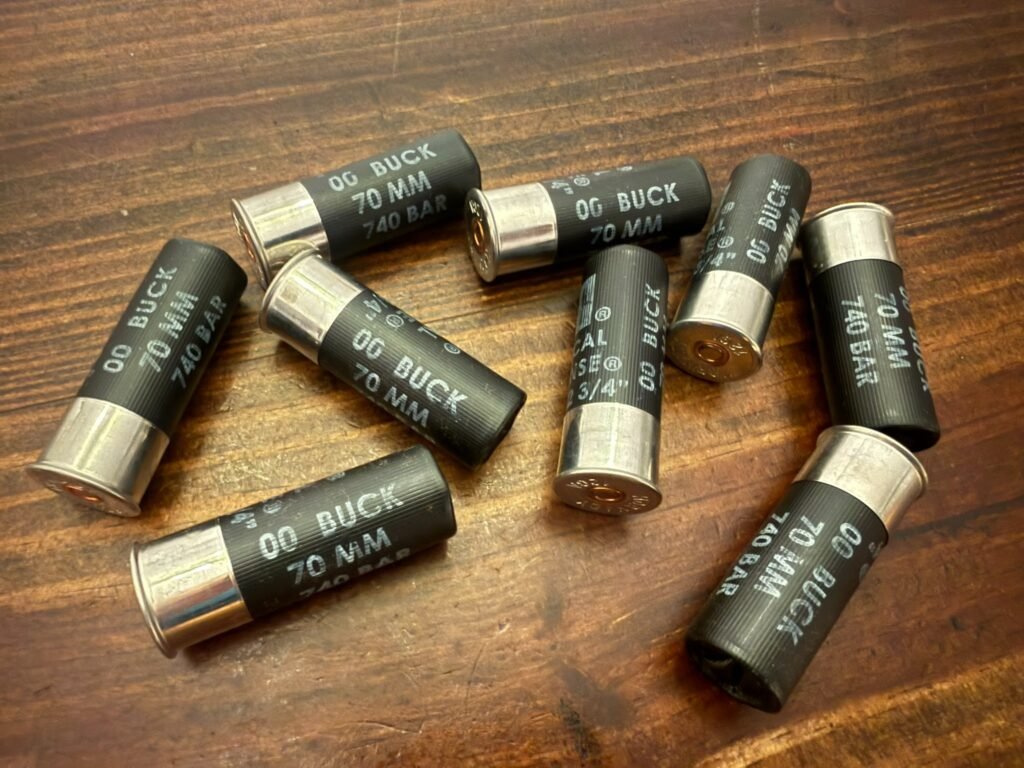
Shotguns and shotgun ammunition are very misunderstood. Even experienced shooters can struggle with understanding how and why shotgun ammo is effective. Hollywood can be blamed for much of that confusion.
The presence of multiple projectiles and a single large slug can create the perception of simplicity. The perception doesn’t hold up under scrutiny, but most don’t have the time to effectively scrutinize their shotgun ammo and why it does or does not work.
With a shotgun and shotgun ammo, distance matters. Patterns matter. Every projectile is going somewhere, and that somewhere matters. To top that off, shotguns generally have a lower capacity and higher recoil than pistols and rifles. All of these factors shape your shotgun’s real-world performance.
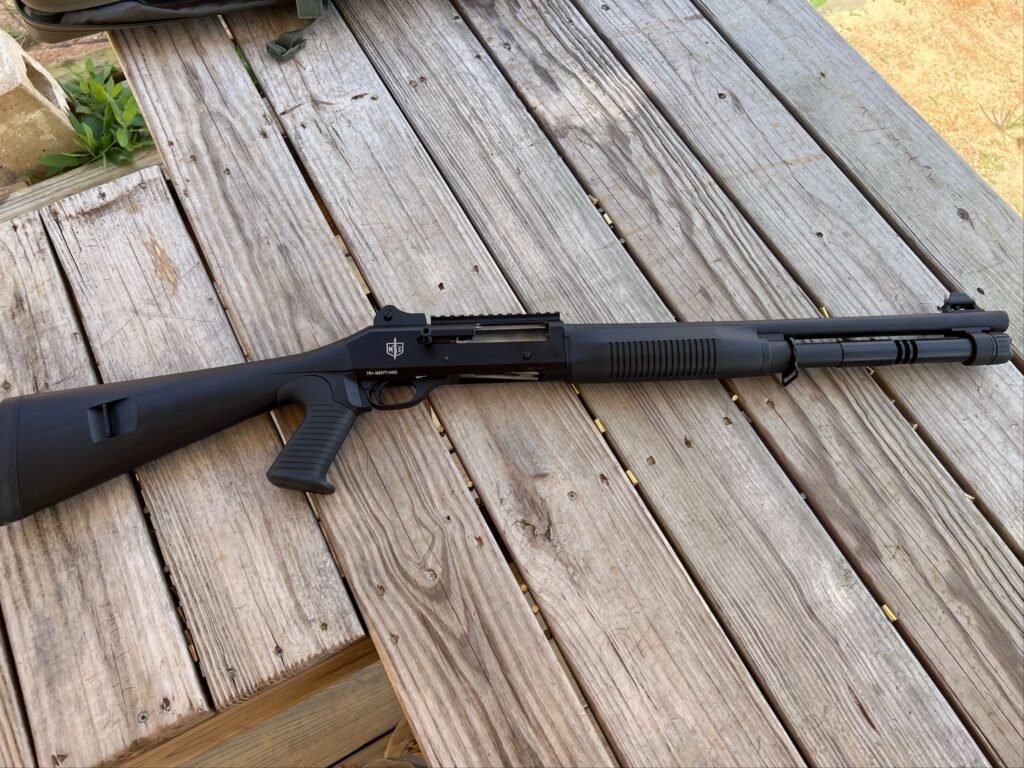
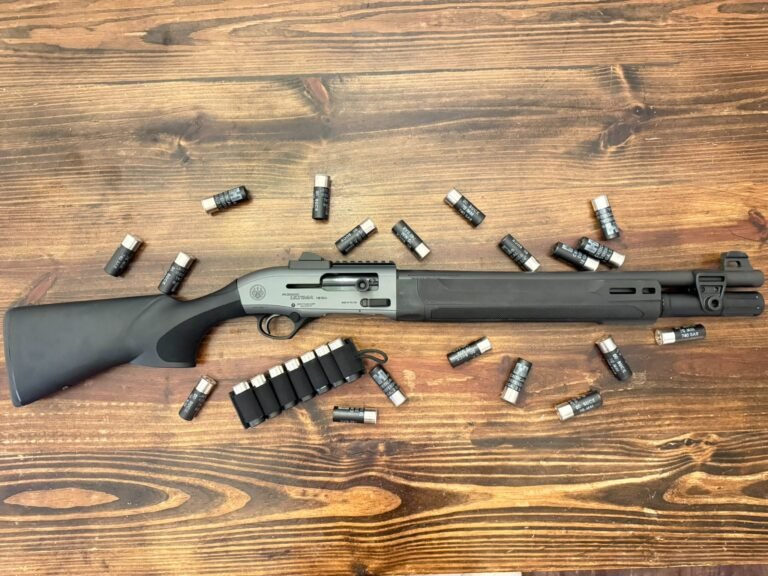
Shotguns firing 00, 0, #, #4, and slugs offer excellent terminal performance per shot that pistols and rifles don’t necessarily match. Shotgun ammo also places real demands on the user. Go spend a day shooting 00 buck from your Maverick 88 and come back and let me know how you feel at the end.
Also, birdshot is never a home defense load. It is a terrible idea and is likely to get you hurt, sued, or arrested if you use it as such.
Common Ammunition Myths in Home Defense
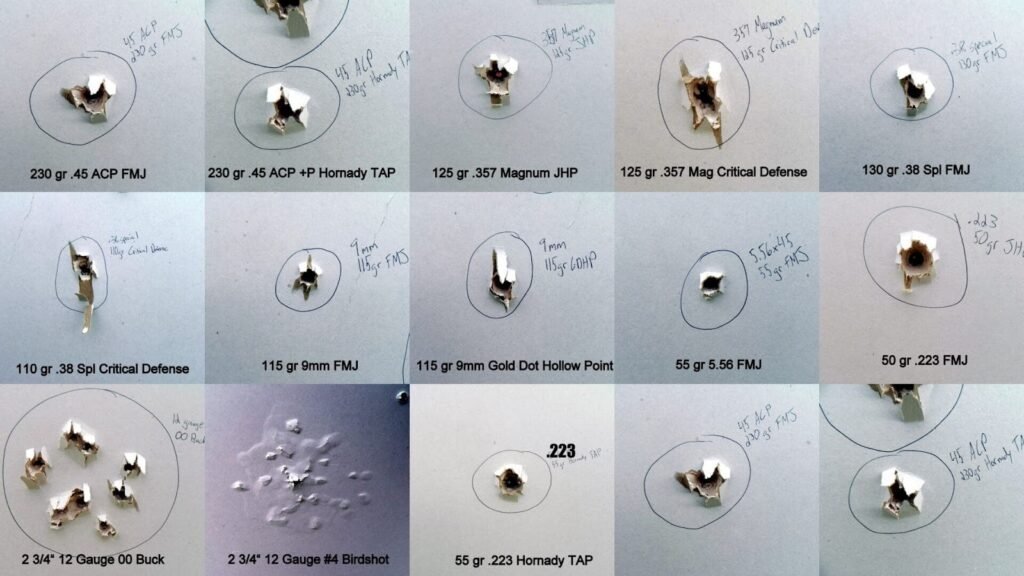
People get a lot of bad information about home defense.
First, the idea that any bullet will automatically stop the threat as long as the gun goes bang is surprisingly common. This simply isn’t true. Real-world incidents show determined attackers can keep going even after taking several hits.
You need high-quality defensive ammo, combined with effective shot placement. Both of these factors are crucial in a home defense situation and are essential to include in your defensive planning. This means training in addition to ammo.
Another common misconception is that more power automatically means better outcomes. If your shots are not on target, then more power usually only means more problems.
A common belief is that the shotgun is the best defensive firearm because more projectiles per shot means you are more likely to hit your target, which can be true; it also means you have more projectiles that can miss your target.
Physics, and the bullet, don’t care what you meant to do. If the bullet has enough energy, it keeps going. Your drywall will not stop the vast majority of projectiles. Any projectile that misses your target will visit every room in your house beyond the target and your neighbors as well.
Thinking About Ammunition as Part of a Complete System
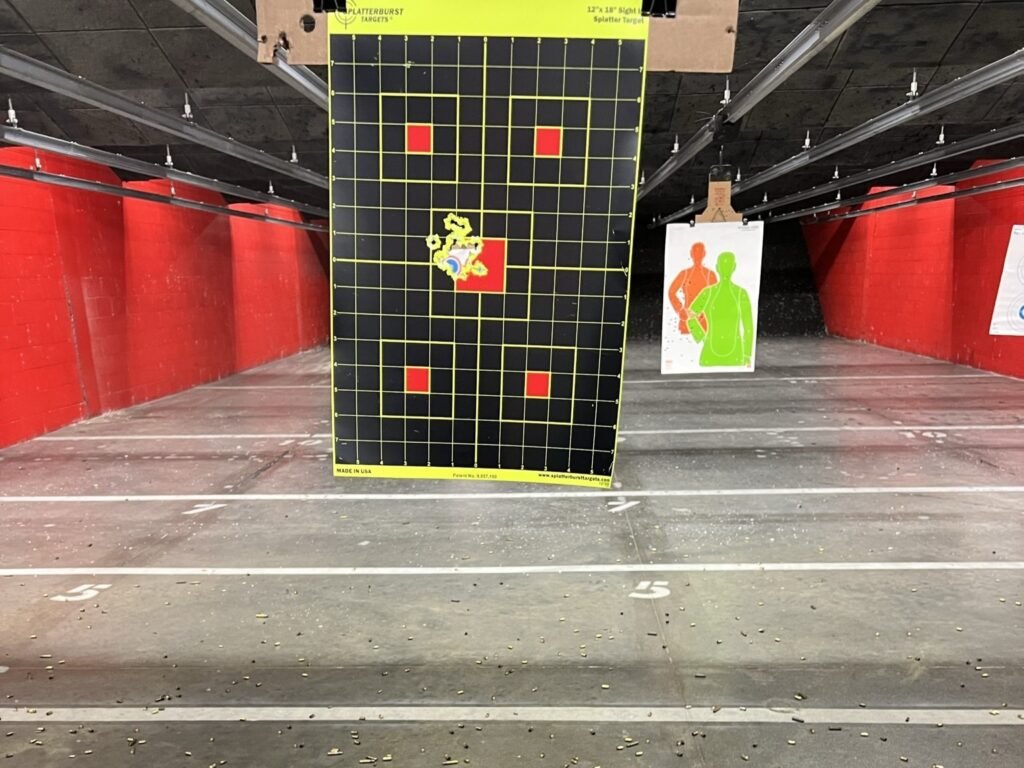
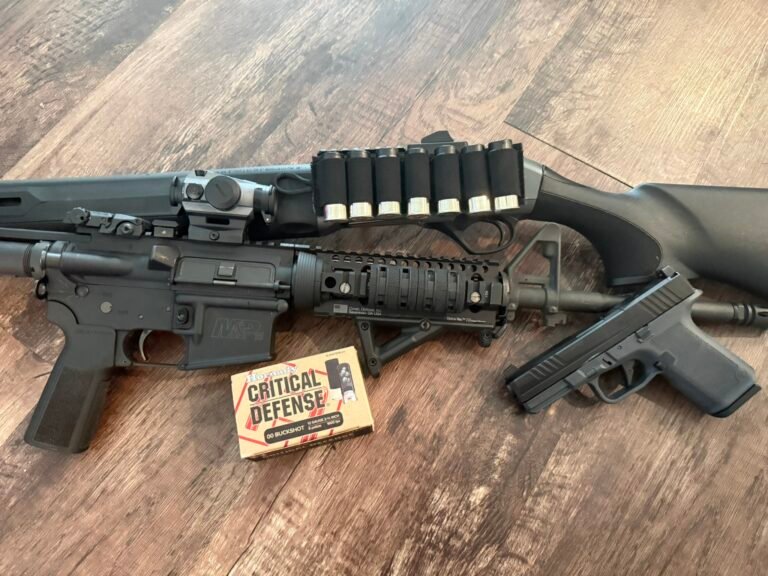
Ammunition does not exist in a vacuum. It is part of a complete setup.
Your ammo interacts with the firearms you choose, the environment, and the person using the firearm. A well-chosen defensive load that has never been tested in the firearm it is loaded into is unknown.
That same defensive ammo, shot enough to know it is reliable and appropriate, is only as good as the hands holding the gun. If there is no training, even simple punching of paper, the gun and ammo will just be a costly club or paperweight.
How to Choose a Defensive Load
Choosing a defensive load is about matching the ammo to your firearm, your home, and your ability to run the gun well. Here’s what to evaluate:
- Start with reliability: find a defensive load that feeds, fires, and ejects flawlessly.
- Penetration and expansion: Look for reputable defensive loads in your caliber that meet FBI ballistic standards, roughly 12–18 inches of penetration in gel and reliable expansion.
- Balance recoil and control: Choose something you can shoot quickly and accurately under stress. If it feels like you got kicked by a mule every time you pull the trigger, you won’t practice with it.
- Consider what lies beyond your target: Manage overpenetration as best you can while ensuring your chosen ammo remains effective.
- Standardize and train: Once you pick a load, stick with it and build reps. Your ammo is only as good as the practice behind it.
Last Words
Home defense ammunition is not about finding perfect answers. It is about adding another effective tool to your home defense toolbox.
You need to understand the tradeoffs when choosing your firearm and defensive ammo. Does the gun handle well? Does it shoot a type of ammo that you can afford to train with and become proficient with? Are the cartridge’s ballistic characteristics acceptable for home use?
.50 BMG will stop the threat, but also will deafen you, temporarily blind you, and the bullet will probably knock a hole in your neighbor’s minivan. Plus, training to become proficient might bankrupt you.
This guide isn’t here to tell you which specific ammo to shoot. It is here to get your brain thinking about what your overall setup looks like and what you need to consider as you build your setup.


Excellent and very informative article. I need to get to the range more.